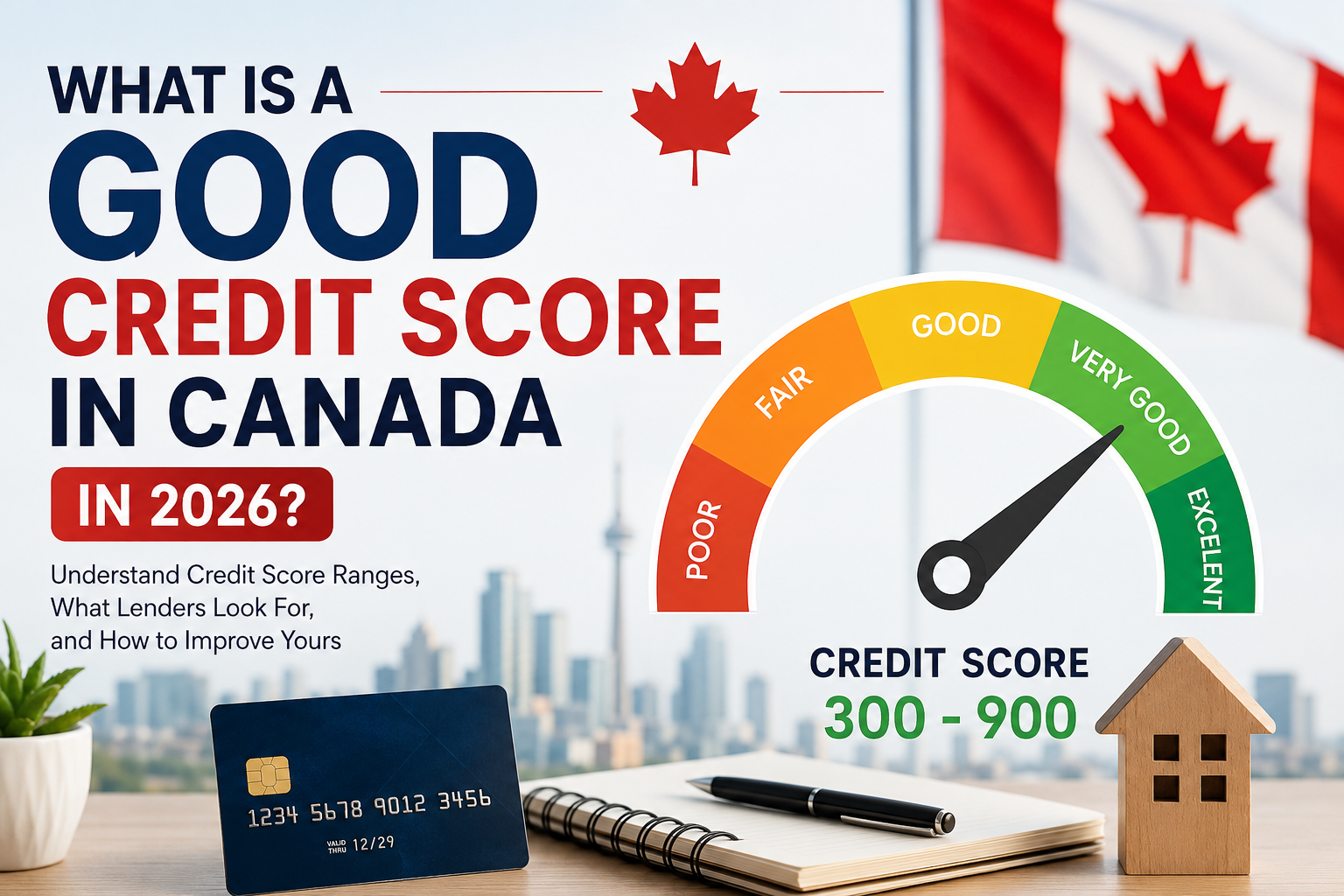
If you are in Canada and want to know What Is a Good Credit Score in Canada in 2026? then this article is for you. In Canada, credit scores generally range from 300 to 900. A score between 660 and 724 is commonly considered good, while scores of 725 or higher fall into the very good or excellent ranges.
However, there is no single credit score that guarantees approval. The score you need depends on the lender, the product you are applying for, and other factors such as your income, existing debt, payment history, and overall credit profile.
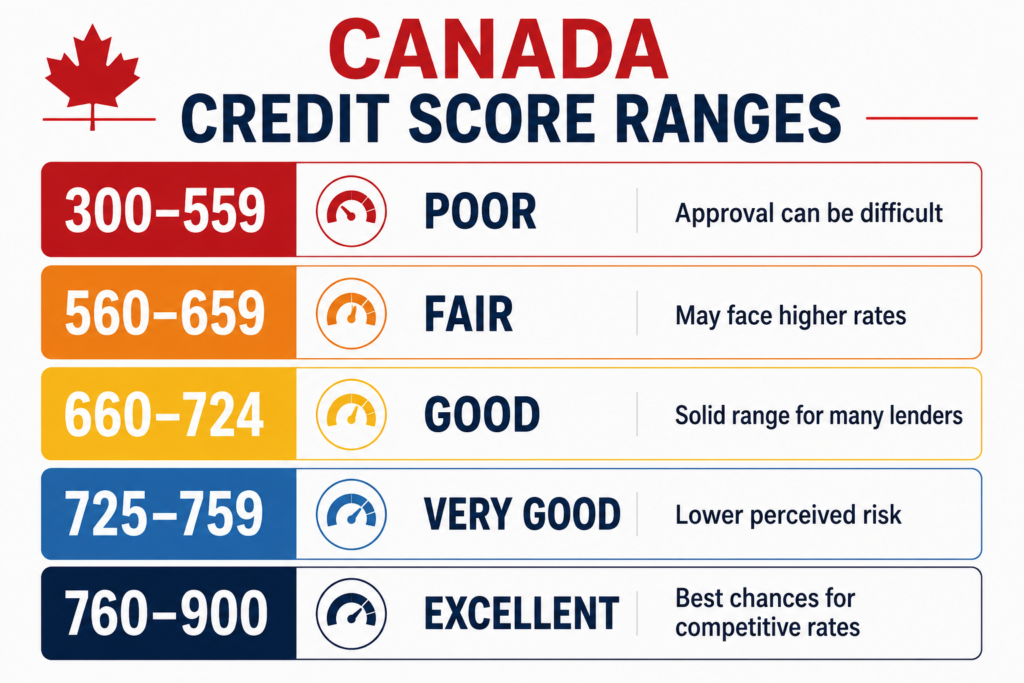
Here is a general breakdown based on Equifax Canada’s published credit score ranges:
- 760–900 — Excellent: May improve your chances of accessing competitive rates and credit products.
- 725–759 — Very Good: Generally indicates a lower level of credit risk to lenders.
- 660–724 — Good: A solid credit range that may help you qualify for many mainstream products.
- 560–659 — Fair: Approval may be more difficult, and available products may have higher interest rates.
- 300–559 — Poor: Traditional credit options may be limited, making secured credit products worth considering.
The reality check: A strong credit score is valuable, but it is only one part of a lender’s decision. Your income, debt obligations and ability to repay may also affect whether you are approved and what interest rate you receive.
What Is a Credit Score?
A credit score is a three-digit number created using information from your credit report. It helps lenders estimate how likely you are to repay borrowed money according to the agreed terms.
Canada has two main credit bureaus:
- Equifax
- TransUnion
These bureaus collect information about your Canadian credit accounts, payment activity, outstanding balances, credit limits, collections and credit inquiries. Each bureau may calculate your score differently, and lenders may also use their own internal risk models. That is why the score you see through one service may not exactly match the score another lender sees.
Your credit score is only one part of a lending decision. A financial institution may also consider your:
- Income
- Employment status
- Current debt
- Monthly expenses
- Payment history
- Relationship with the institution
- Type and amount of credit requested
For newcomers beginning their financial journey, opening a suitable bank account is often an important first step. Read WiseBlog’s guide to opening your first bank account in Canada.
Credit Score Ranges in Canada
The following table uses the consumer ranges published by Equifax Canada. These labels provide a useful general benchmark, but they are not binding rules for every lender.
Credit score General rating What it may indicate 300–559 Poor Approval may be more difficult, and available products may have higher costs 560–659 Fair Some products may be available, but stronger terms may be harder to obtain 660–724 Good A generally healthy credit range with improved approval possibilities 725–759 Very Good May provide access to more competitive products and rates 760–900 Excellent Generally represents strong credit management and lower perceived risk These categories should not be treated as guarantees. TransUnion notes that each lender decides what it considers a good or poor credit risk, and lenders may evaluate additional information alongside your score.
Is 660 a Good Credit Score in Canada?
Yes. Under Equifax Canada’s commonly published ranges, 660 is the beginning of the good credit category.
A score around 660 may make it easier to qualify for some standard credit cards, loans or financing options than a score in the fair or poor categories. However, it does not automatically guarantee approval or the lowest available interest rate.
A lender may decline an applicant with a score above 660 because of high debt, insufficient income, recent missed payments or too many recent applications. Another applicant with the same score may be approved because their overall financial profile is stronger.
Your goal should therefore be broader than simply reaching 660. Focus on developing a stable credit report, manageable debt and reliable payment habits.
Is 700 a Good Credit Score in Canada?
Yes. A score of 700 falls within the good credit range under Equifax Canada’s published categories.
A 700 score may indicate that you have generally handled your credit responsibly. It may improve your access to standard lending products, although approval and pricing still depend on the lender’s own assessment.
If your score is already around 700, continue protecting it by:
- Paying every bill on time
- Keeping balances low
- Avoiding unnecessary credit applications
- Reviewing your credit reports regularly
- Keeping older no-fee accounts open when practical
Why Does a Good Credit Score Matter in Canada?
Banks, credit unions, credit-card issuers and other organizations may use your credit report and score when deciding whether to provide a service.
Your credit information may affect decisions involving:
- Credit cards
- Personal loans
- Lines of credit
- Car financing or leasing
- Mortgages
- Credit-limit increases
- Apartment rentals
- Mobile phone or internet accounts
- Some insurance or employment decisions
A stronger score may also help you receive a more competitive interest rate. For example, the Financial Consumer Agency of Canada states that a higher score may help borrowers obtain better rates, while a lower score may result in higher borrowing costs or declined applications.
A credit score should not be viewed as a measure of personal worth or financial success. It is primarily a risk-assessment tool based on how you have managed reported credit accounts.
What Factors Affect Your Credit Score?
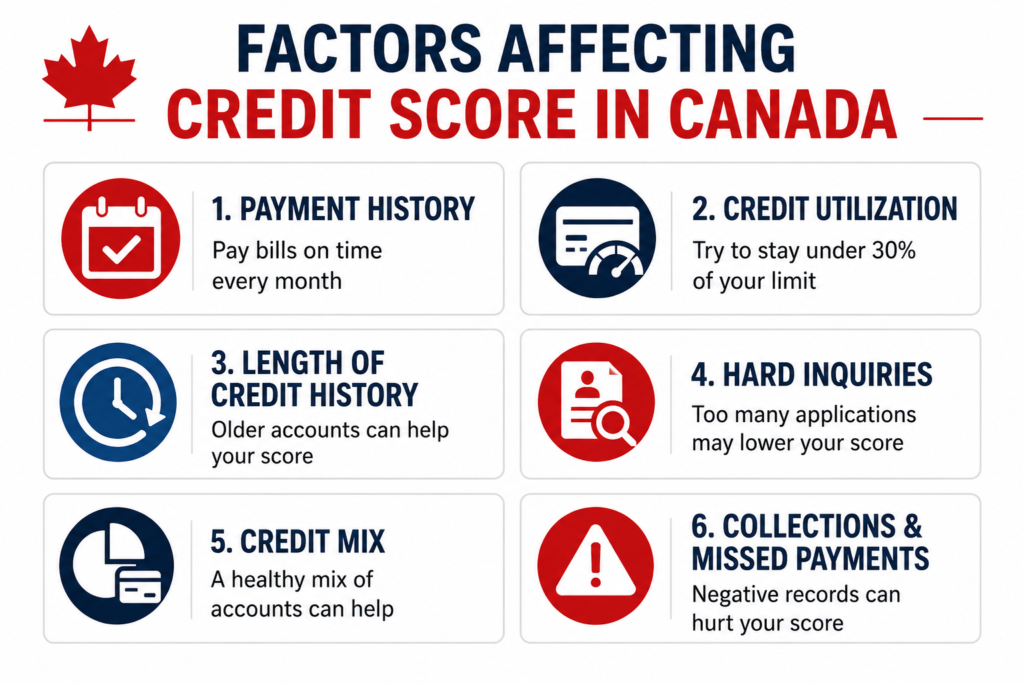
The exact formulas used by Equifax, TransUnion and lenders are not publicly disclosed. However, the Government of Canada identifies several major factors that commonly influence credit scores.
1. Payment History
Payment history is one of the most important parts of your credit profile.
Late or missed payments may lower your score and remain on your report for a period of time. Paying at least the required minimum by the due date helps demonstrate that you are a reliable borrower.
Setting up automatic payments or calendar reminders can reduce the risk of accidentally missing a due date.
2. Credit Utilization
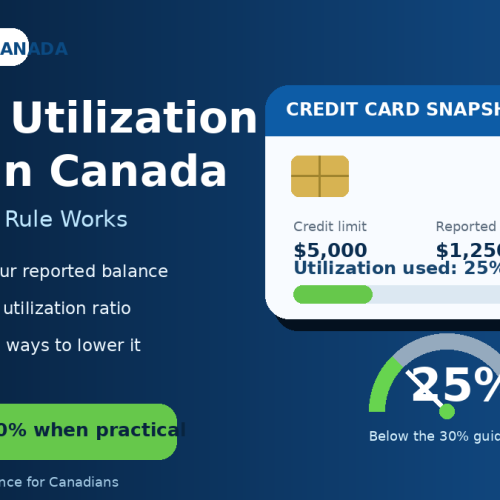
Credit utilization compares your reported credit-card balances with your available credit limits.
For example, if your total credit limit is $2,000 and your reported balances total $400, your utilization rate is 20%.
The Financial Consumer Agency of Canada recommends trying to use less than 30% of your total available credit. A consistently high balance may be interpreted as greater reliance on borrowed money, even when you pay the balance later.
3. Length of Credit History
A longer and stable credit history may help lenders understand how you manage credit over time.
Closing an older account can shorten your active history and reduce your total available credit. However, you should not keep an account open if it charges unnecessary fees, creates a risk of overspending or is difficult to monitor.
4. Credit Applications and Hard Inquiries
When you apply for a credit card, personal loan or mortgage, the lender may perform a hard credit inquiry.
A single inquiry is usually not a major concern, but several applications made within a short period may make you appear financially stressed or overly dependent on credit.
Checking your own report or score is considered a soft inquiry and does not lower your credit score.
5. Types of Credit
Your credit file may include different products, such as:
- Credit cards
- Lines of credit
- Car loans
- Student loans
- Mortgages
Managing more than one type of credit responsibly may strengthen your credit profile. This does not mean that you should take out unnecessary loans simply to improve your score. Only borrow money that you can reasonably repay.
6. Collections and Serious Negative Information
Unpaid accounts that are sent to a collection agency can damage your score. Bankruptcy, consumer proposals and other serious negative records may also affect your ability to access credit.
Contact your lender early if you believe you will have difficulty making a payment. Waiting until an account reaches collections can make the situation more difficult to resolve.
How to Check Your Credit Report and Score in Canada
You can access your credit report online through Canada’s two main credit bureaus, Equifax and TransUnion.
The Government of Canada states that both bureaus provide access to free credit reports. Checking your own report or score does not damage your credit rating.
Use the official Government of Canada instructions to get your credit report and credit score.
When reviewing your report, check:
- Your full name and address
- Credit accounts that belong to you
- Current balances and credit limits
- Payment-history information
- Closed accounts
- Collection accounts
- Credit inquiries
- Accounts that you do not recognize
Avoid entering sensitive information on unfamiliar websites that promise an instant credit score. Start with the Government of Canada, Equifax or TransUnion.
Why Are My Equifax and TransUnion Scores Different?
It is normal for your Equifax and TransUnion scores to be different.
Possible reasons include:
- The bureaus may use different scoring models
- A lender may report to only one bureau
- Information may be updated on different dates
- One report may contain information that the other does not
- A lender may use a different score version from the consumer score you see
Focus on the accuracy and overall direction of both reports rather than expecting both numbers to be identical. Credit scores are snapshots that can change as account information is updated.
How to Improve Your Credit Score in Canada
Improving a credit score generally requires consistent habits rather than a quick trick.
Pay every account on time
Make at least the minimum payment before the due date. Paying the full statement balance can also help you avoid interest charges.
Keep utilization below 30%
Try not to let reported balances regularly exceed 30% of your combined limits. Lower utilization may be even better when it is manageable.
Limit unnecessary applications
Research products before applying and avoid submitting several applications at the same time.
Keep useful older accounts open
An older no-fee account may support the length of your credit history and your available credit. Continue monitoring it for unauthorized activity.
Review both credit reports
Errors, duplicate accounts or fraudulent activity may affect your file. The Government of Canada states that you have the right to dispute inaccurate information, and credit bureaus must correct confirmed errors without charging you. Learn how to check and dispute credit-report errors.
Borrow only what you can repay
Taking on additional debt solely to improve your credit mix may create more harm than benefit.
For a detailed step-by-step plan, read How to Build Credit in Canada: 9 Practical Steps for Newcomers and Students.
You may also find it useful to review WiseBlog’s Personal Finance Canada 2026 guide for budgeting and financial-planning ideas.
How Long Does It Take to Get a Good Credit Score?
There is no guaranteed timeline for reaching a particular credit score.
The result depends on:
- Whether you are building a new file or repairing damaged credit
- How many reported accounts you have
- Your payment history
- Your reported balances
- Recent applications
- Collections or other negative information
- How frequently lenders update your accounts
A newcomer or student should focus on steady habits rather than trying to raise the score by a certain number each month. Credit improvement takes time, and TransUnion emphasizes that responsible credit use is generally the foundation of a healthier score
Common Canadian Credit Score Myths
Checking your own score lowers it
False. Checking your own credit report or score is a soft inquiry and does not reduce your score.
You must carry a balance to build credit
False. You do not need to pay interest to build a payment history. You may use the card for manageable purchases and pay the statement balance by the due date. The Government of Canada recommends aiming to pay off the balance each month.
A high income automatically produces a high score
False. Your credit score is primarily based on information contained in your credit report. Income may be considered separately by a lender, but a higher salary does not automatically repair missed payments or high balances.
All lenders use the same score
False. Bureaus and lenders may use different models, and each lender establishes its own approval standards.
Closing every unused card improves your score
Not necessarily. Closing an older account may shorten your active history and reduce your available credit. Consider the fees, security and spending risks before deciding.
Frequently Asked Questions
Is 600 a good credit score in Canada?
Under Equifax Canada’s published consumer ranges, 600 is generally classified as fair rather than good. However, different lenders may use different labels and approval standards.
Is 650 a good credit score in Canada?
A score of 650 is close to the commonly cited good range but remains within Equifax’s fair category. Consistent payments and lower utilization may help move the score upward over time.
Is 700 a good credit score in Canada?
Yes. A score of 700 falls within the commonly cited good range of 660 to 724.
What credit score is required to rent an apartment?
Canada does not have one universal minimum credit score for renting. Individual landlords and property-management companies establish their own requirements. They may consider your score, income, references, employment and rental history. In most provinces, consent is required before an organization checks your credit.
What credit score is needed for a car loan?
There is no single required score for every car loan. The lender may consider your score, income, down payment, current debt, vehicle cost and repayment term.
Can a newcomer build credit without foreign credit history?
Yes. Canadian credit bureaus primarily collect Canadian credit activity, so newcomers can begin establishing a local history through responsibly managed Canadian credit products. Read WiseBlog’s complete credit-building guide for newcomers.
Why did my credit score suddenly drop?
A drop may result from a newly reported balance, late payment, hard inquiry, closed account, reduced credit limit, collection record or change in the scoring model. Review both reports before assuming there is a serious problem.
Final Thoughts
A score between 660 and 724 is generally considered a good credit score in Canada, while scores above 725 are typically considered very good or excellent under Equifax Canada’s published ranges.
However, there is no single score that guarantees approval. Lenders may also assess your income, debt, employment, payment history and the type of product you are requesting.
The most effective approach is straightforward:
- Pay bills on time
- Keep credit-card balances manageable
- Limit unnecessary applications
- Review your reports for errors
- Borrow only what you can repay
- Give your credit history time to develop
A credit score is not something that needs to be perfect. It needs to be accurate, stable and strong enough to help you meet your financial goals.
Disclaimer: This article is for general informational purposes only and does not constitute financial, legal or credit advice. Credit-scoring models and lender requirements may vary.