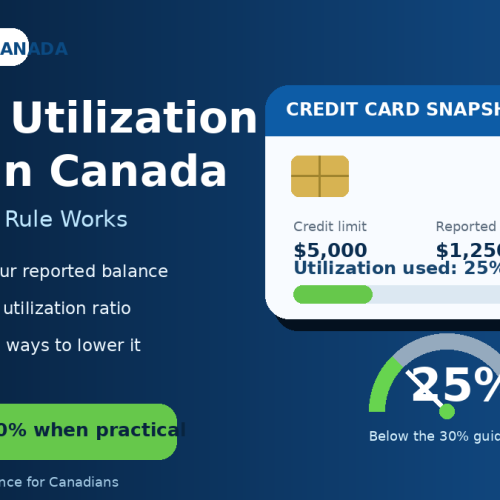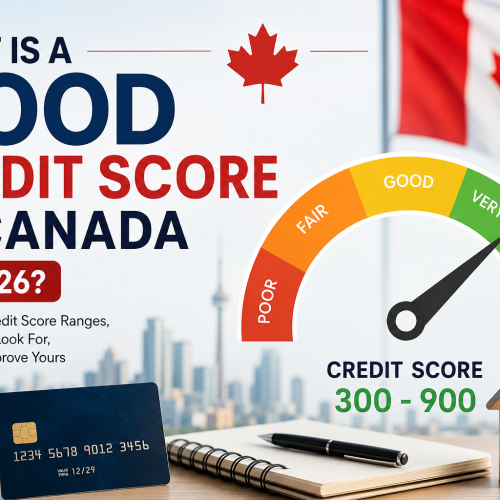
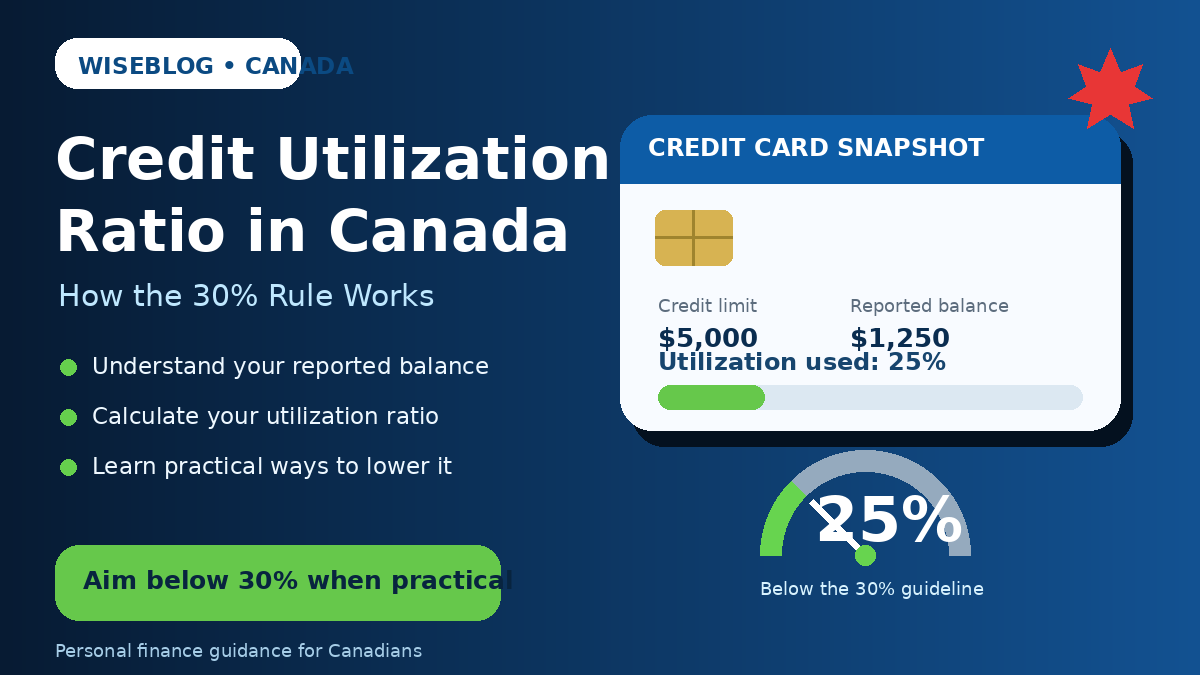
The credit utilization ratio in Canada can affect your credit score even when you pay every credit-card bill on time.
You can pay every credit-card bill on time and still wonder why your credit score is not improving as quickly as expected.
One possible reason is your credit utilization ratio.
Credit utilization simply measures how much of your available credit you are currently using. For example, if your credit card has a $2,000 limit and the reported balance is $1,000, your utilization is 50%.
In Canada, the Financial Consumer Agency of Canada recommends trying to use less than 30% of your available credit. That does not mean your score suddenly becomes bad at 31%, but it gives you a useful target for managing your cards responsibly.
This guide explains how the credit utilization ratio in Canada works, how to calculate it, and what you can do when your balance is regularly too high.
Quick note: Credit bureaus do not publish their complete scoring formulas. Credit utilization matters, but it is only one part of your overall credit history.
nt factors.
What Is a Credit Utilization Ratio?
Your credit utilization ratio compares your current revolving debt with your available revolving credit.
It usually applies to accounts such as:
- Credit cards
- Retail store cards
- Revolving lines of credit
Suppose you have a credit card with a $3,000 limit and a reported balance of $600.
Your utilization would be:
$600 ÷ $3,000 × 100 = 20%
That means you are using 20% of the credit available on that card.
A lower ratio generally shows lenders that you are not relying too heavily on borrowed money. A high ratio may suggest that your finances are stretched, even when you have never missed a payment.
Before focusing only on utilization, read WiseBlog’s guide to How to Build Credit in Canada for a broader look at payment history, credit age, inquiries, and other important factors.
How to Calculate Credit Utilization
The calculation is simple:
Credit utilization = Reported balance ÷ Credit limit × 100
Example 1: Low utilization
- Credit limit: $1,000
- Reported balance: $150
$150 ÷ $1,000 × 100 = 15%
Your utilization is 15%.
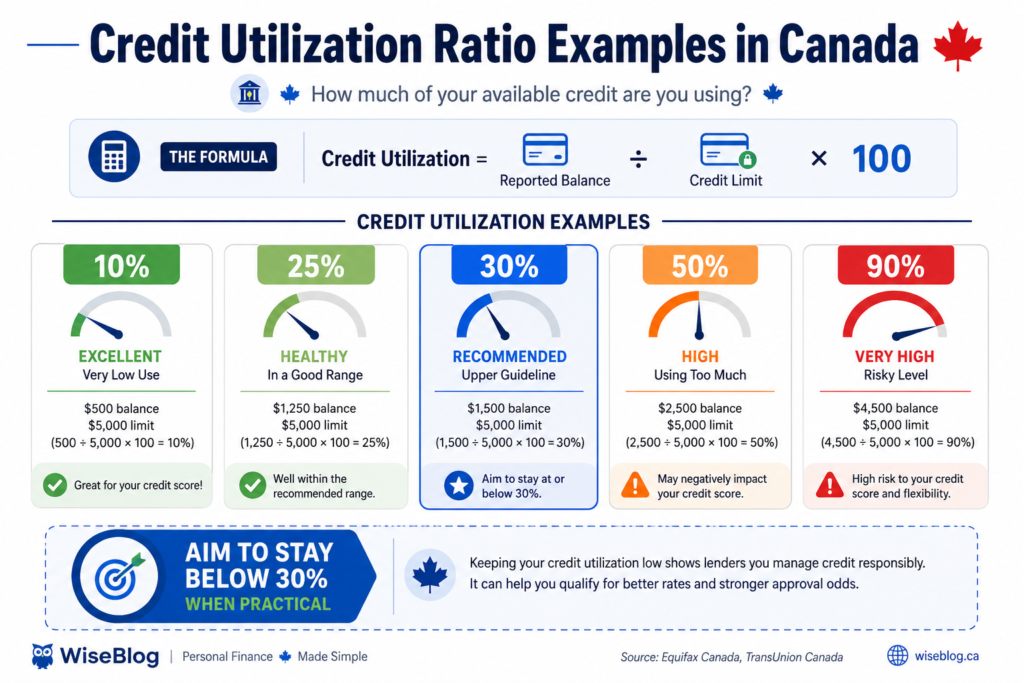
Example 2: High utilization
- Credit limit: $1,000
- Reported balance: $800
$800 ÷ $1,000 × 100 = 80%
Even when you plan to pay the full $800 by the due date, an 80% balance may still appear high if that amount is reported to the credit bureaus.
What Is a Good Credit Utilization Ratio in Canada?
The Government of Canada recommends trying to use less than 30% of your total available credit.
Here is a practical way to understand different utilization levels:
| Utilization | What it may indicate |
|---|---|
| Below 10% | Very low credit use |
| 10%–29% | Generally within the recommended range |
| 30%–49% | Above the usual guideline |
| 50%–79% | High credit usage |
| 80%–100% | Very high usage |
| Above 100% | Over the credit limit |
These are not official score categories. A person with 20% utilization is not automatically guaranteed a better score than someone using 35%.
Your payment history, account age, credit applications, collections, and total debt can also affect your score.
To understand how your utilization fits into your complete credit profile, read WiseBlog’s guide on What Is a Good Credit Score in Canada?
Is the 30% Rule Exact?
No. Think of 30% as a guideline rather than a strict pass-or-fail line.
Your credit score will not necessarily drop the moment your utilization changes from 29% to 31%. Similarly, staying under 30% does not guarantee a specific score increase.
Still, keeping your balance comfortably below your limit can make your credit profile look more manageable.
For example, when your limit is $1,000, it may be easier to aim for a reported balance below $300 rather than trying to stay exactly at 30%.
Overall Utilization vs. Individual Card Utilization
Credit utilization may be considered across all your cards and on each card individually.
Imagine that you have two credit cards:
| Card | Credit limit | Balance |
|---|---|---|
| Card A | $1,000 | $800 |
| Card B | $3,000 | $0 |
| Total | $4,000 | $800 |
Your overall utilization is 20%.
However, Card A is using 80% of its available limit.
Even though your total ratio looks reasonable, one individual card is close to being maxed out. This is why spreading normal expenses across cards, or paying down a heavily used card earlier, may help keep each account manageable.
That does not mean you should use several cards unnecessarily. The goal is simply to avoid repeatedly pushing one account close to its limit.
When Is Your Balance Reported?
Many people assume that the balance reported to the credit bureaus is the balance shown in their banking app today.
That is not always the case.
Credit-card issuers usually report account information periodically, often around the time your statement is prepared. Reporting schedules can vary by lender.
For example, you might:
- Spend $900 on a card with a $1,000 limit.
- Receive a statement showing the $900 balance.
- Pay the full amount before the payment deadline.
- Still have the $900 balance temporarily appear on your credit report.
You avoided a late payment, but the reported utilization may still be 90% until the lender sends a newer balance.
Statement Date vs. Payment Due Date
The statement date and payment due date serve different purposes.
Statement date
This is the day your billing cycle closes. Your statement balance is calculated around this date, and the lender may report that amount to the credit bureaus.
Payment due date
This is the deadline for making the required payment.
Paying by the due date helps protect your payment history. Paying part of the balance before the statement date may help lower the amount that gets reported.
You should still review your actual statement and card agreement because reporting practices differ between financial institutions.
Can High Utilization Affect You When You Pay in Full?
It can.
Paying your balance in full is an excellent habit because it can help you avoid interest and late-payment problems. However, the balance reported before your payment may still affect your utilization.
Consider this example:
- Credit limit: $2,000
- Monthly spending: $1,600
- Statement balance: $1,600
- Utilization: 80%
You may pay the full $1,600 by the deadline, but your credit report could temporarily show that you used most of your limit.
A practical solution is to make an extra payment before the statement closes. This is especially useful when you have a low credit limit but use the card for many everyday purchases.
How to Lower Your Credit Utilization
Pay down existing balances
Reducing the amount you owe is the most direct way to lower your ratio.
Start with cards that are:
- Close to their limits
- Charging high interest
- Carrying balances from month to month
Continue making at least the required payment on every account.
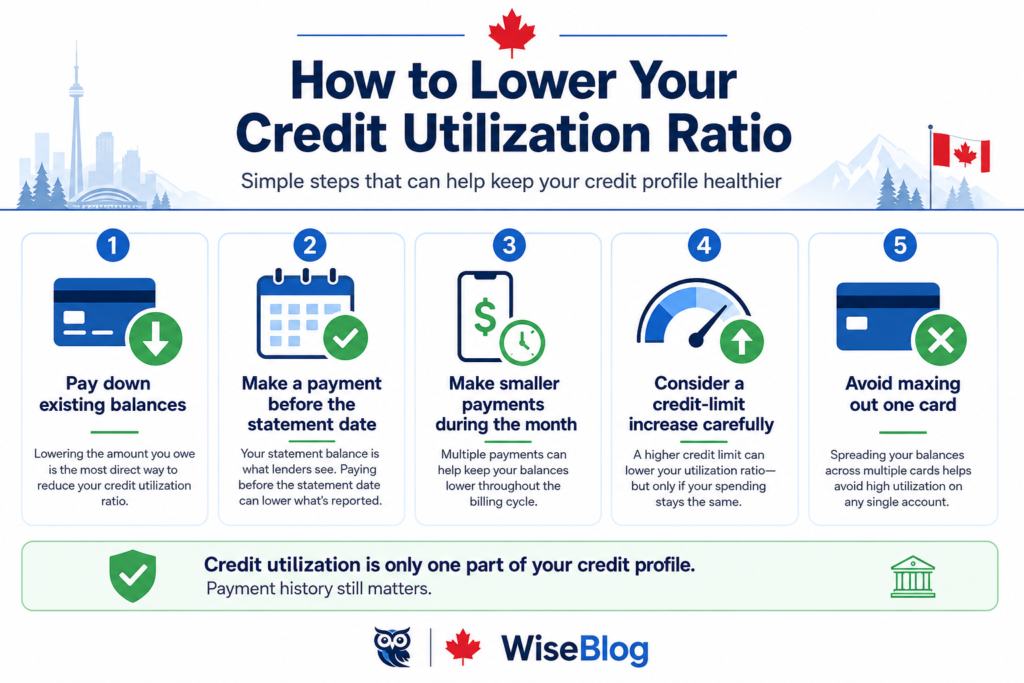
Make an early payment
You do not always have to wait for the due date.
Suppose your card has a $1,000 limit and your balance reaches $700. Paying $500 before the statement closes could leave a reported balance of approximately $200.
That would reduce the possible utilization from 70% to 20%.
The exact result depends on when your lender reports the account.
Make smaller payments during the month
Some people find it easier to make weekly or biweekly payments instead of one large payment.
This can help you monitor spending and prevent the balance from getting too close to the limit.
For example, you could pay the card every Friday or whenever the balance reaches a certain amount.
Turn on balance alerts
Most Canadian banks allow customers to create account alerts.
You could set an alert when:
- Your balance reaches a chosen amount
- Your available credit becomes low
- A payment is due
- A transaction exceeds a certain value
For a card with a $1,000 limit, an alert at $250 or $300 may help you stay aware of your utilization.
Consider a credit-limit increase carefully
A higher limit can reduce your utilization when your spending remains unchanged.
For example:
- Balance: $500
- Current limit: $1,000
- Current utilization: 50%
After an increase to $2,000:
- Balance: $500
- New utilization: 25%
Before requesting an increase, ask the issuer whether it will involve a hard credit check.
More available credit should not become an excuse to spend more. A higher limit only helps when your balance stays under control.
Think carefully before closing an old card
Closing a credit card reduces your total available credit.
Suppose your total credit limits equal $5,000 and your combined balance is $1,000. Your utilization is 20%.
If you close a card with a $2,000 limit, your available credit falls to $3,000. The same $1,000 balance would now create a utilization ratio of about 33%.
Keeping an older no-fee account open may help preserve your available credit and credit history. However, closing it may still be reasonable when it has an expensive annual fee, creates a security concern, or encourages overspending.
Common Credit Utilization Mistakes
Waiting until the due date to pay a very high balance
Paying on time is important, but the high balance may already have appeared on your statement.
Maxing out a card for rewards
Cashback and travel points are rarely worth financial stress or interest charges. Rewards only help when the purchases already fit within your budget.
Carrying a balance because you think it builds credit
You do not need to pay interest to build credit. Responsible activity and on-time payments matter more than carrying unnecessary debt.
Closing a card without checking the effect
Before closing an account, calculate how much available credit you will have left.
Applying for several cards at once
More cards may increase your available credit, but several applications can also create hard inquiries and new accounts. Apply only when the product has a genuine purpose.
Ignoring errors on your credit report
An incorrect balance or credit limit could make your utilization appear higher than it really is.
You can follow the Government of Canada’s instructions for accessing your credit reports from Equifax and TransUnion. Reviewing your own report does not lower your credit score.
You can
access your Canadian credit reports through the official Government of Canada instructions
and review information reported by Equifax and TransUnion.
A Simple Monthly Routine
Managing utilization does not need to become complicated.
Once a week, check your card balances. When a balance becomes higher than expected, make an early payment if your budget allows.
Before the statement date, review how much of each limit you are using. Then make sure the required payment is completed before the due date.
You can also check your credit reports periodically to confirm that account limits and balances are being reported correctly.
Frequently Asked Questions
Is 30% credit utilization good in Canada?
Thirty percent is generally treated as the upper edge of the recommended range. Staying below it when practical may help show that you are managing your available credit carefully.
Is 10% better than 30%?
Lower utilization may look less risky, but no percentage guarantees a particular credit score. Your overall credit history still matters.
Does 0% utilization hurt your score?
You do not need to create debt just to report a balance. A zero balance is not automatically harmful, and you should never carry debt solely because you believe it will improve your score.
How quickly can utilization change on my credit report?
It depends on when your lender reports updated account information. A lower balance may not appear immediately after you make a payment.
Does checking my own credit report affect my score?
No. Reviewing your own credit report is generally considered a soft inquiry and does not lower your score.
Should I increase my credit limit?
A higher limit may reduce your utilization, but only when your spending stays the same. Ask whether the request requires a hard credit check and make sure the larger limit will not encourage overspending.
Final Thoughts
The credit utilization ratio in Canada is fairly simple: it compares your reported revolving balance with your available credit.
You do not need to obsess over one exact number. Instead, focus on keeping balances manageable, avoiding maxed-out cards, and making every required payment on time.
When your utilization regularly becomes high, consider paying before the statement date, using balance alerts, or reducing spending until the balance is under control.
Credit utilization is important, but it is not the whole story. Payment history, account age, inquiries, and the accuracy of your credit report also play a role.
Continue with WiseBlog’s guides on How to Build Credit in Canada and What Is a Good Credit Score in Canada? for a more complete credit-building plan.
Continue learning with WiseBlog’s
complete Canadian credit-building guide
and our guide explaining
what counts as a good credit score in Canada
.
Disclaimer: This article provides general information only. It is not financial, legal, or credit advice. Credit-scoring models, lender policies, and reporting schedules may vary.